Huizhou Architecture A Village Route for First Time Visitors
A practical guide to Huizhou Architecture A Village Route for First Time Visitors.

What makes Huizhou architecture distinct
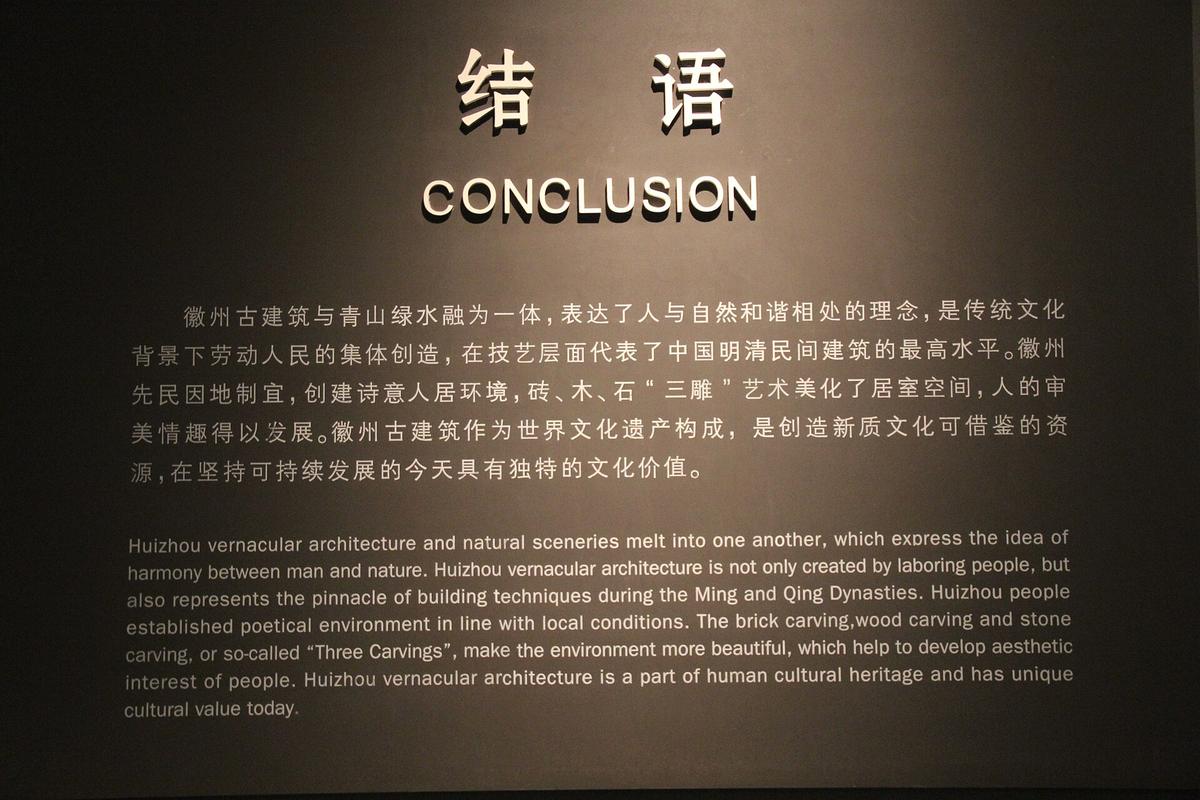
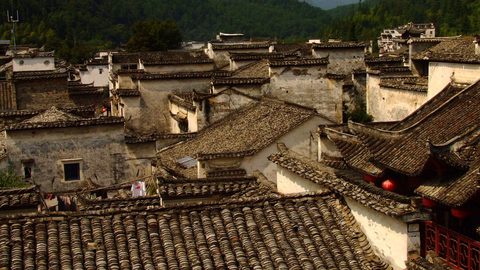
The villages of southern Anhui hold one of China's most immediately recognisable architectural traditions. Approaching Xidi or Hongcun, the eye catches the rhythmic rise and fall of stepped gable ends against the sky. These are horse-head walls, the whitewashed lime surfaces capped with dark grey fired-clay tiles, their triangular extensions stepping upward at each roof line. The contrast is deliberately stark: bright plaster, deep tile, and the narrow stone lanes that thread between them.
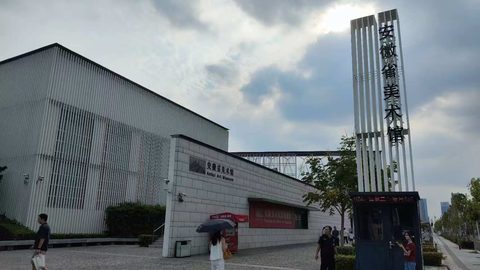
Behind that silhouette lies a building culture shaped by the merchant families who made their fortunes far from these valleys and returned to build with restraint and precision. The Anhui Museum identifies three structural forms as the core of the tradition: civilian dwellings, ancestral halls and memorial arches. Together they are known as the three gems of Huizhou-style building. A visitor moving through either village encounters all three within the first hour, and the repetition teaches the eye what to value: proportion over ornament on the exterior, and extraordinary craft reserved for the spaces within.
The two UNESCO villages at a glance
Xidi and Hongcun, located in Yi County within the Huangshan municipality, were jointly inscribed as a UNESCO World Heritage Site in 2000. The listing covers a combined 52 hectares of protected property and preserves village layouts, architecture and water systems that date from the 14th through to the 20th centuries.
The two villages sit roughly 18 kilometres apart by road. A shuttle bus connects them, and the journey takes about 20 to 25 minutes. Despite their proximity and shared heritage status, they reward different kinds of attention. Xidi reads as a compact, linear settlement: a boat-shaped plan roughly 700 metres long and 300 metres wide, organised along two streams, with 124 Ming and Qing dynasty buildings still standing. Hongcun feels more expansive and deliberately composed around water, its working 15th-century hydraulic system still feeding the Moon Pond at the village centre and the South Lake at its southern edge. Around 140 Ming and Qing residences survive there.
Choosing between them is a question of rhythm rather than quality. Xidi offers density and a clear architectural narrative along its main watercourse. Hongcun rewards slower wandering and attention to the way water shapes daily space. A visitor with a full day can see both; the shuttle makes the connection straightforward. Someone with only a morning might prefer Xidi for its concentrated streetscape, while an afternoon at Hongcun suits those drawn to landscape and reflection.
Reading the horse-head wall and the whitewashed exterior
The horse-head wall is the defining exterior gesture of Huizhou architecture. Its practical origin was fire protection: the stepped gables rise above the roofline to block flames from spreading between closely packed timber structures. Over centuries the form became an aesthetic signature, and the rhythm of multiple walls stepping up and down along a lane creates a skyline that is both martial and graceful.
The whitewashed lime render and dark tile roofing complete the palette. The walls are not painted white in the modern sense; the lime plaster weathers to a soft, mottled grey-white that holds the dampness of the southern Anhui climate. On an overcast morning the walls seem to absorb light rather than reflect it, and the dark tiles above read almost as calligraphic strokes. This restrained exterior gives little away. Doorways are modest, windows few and small. The wealth and taste of the merchant household were expressed inside, away from the street.
The Three Carvings and the merchant interior
Step through a narrow entrance and the visual economy reverses. The interiors of Huizhou merchant houses are renowned for the Three Carvings: wood, stone and brick. Wood carving dominates the beams, screen panels and window lattices, with motifs drawn from literature, folk tales and the natural world. Stone carving appears on gate pillars, plinths and the great memorial archways. Brick carving decorates entrance façades, often in layered relief that catches the light from the narrow skywell above.
The carvings were not merely decorative. They communicated the values of a household: filial piety, scholarly aspiration, commercial integrity. A carved beam might depict a scene from a classic novel; a lattice window might encode a wish for longevity or harmony. The materials themselves spoke of the Huizhou merchant's world: timber from the mountains, stone quarried locally, brick fired from the same clays that produced the roof tiles. The craft tradition is integral to the UNESCO listing and remains legible even where paint has faded and wood has darkened with age.
The Hu Wenguang Memorial Archway
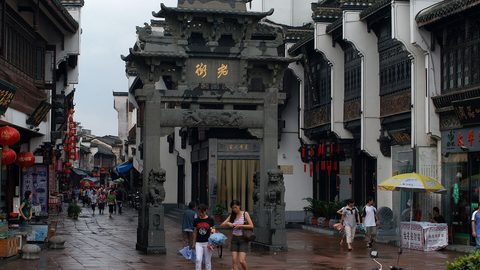
At the entrance to Xidi stands the Hu Wenguang Memorial Archway, a Ming dynasty stone structure dated to 1578. It rises 12.3 metres tall and spans 9.95 metres wide in a four-pillar, three-bay, five-tier form. The surface is carved with dragons, phoenixes and other motifs, and the archway functions as both a monument to an individual and a statement of the village's status.
Memorial archways are one of the three gems of Huizhou architecture, and this example is the most prominent in either village. It marks the threshold between the modern road and the historic street plan, and its scale relative to the surrounding buildings makes clear that it was always meant to be seen from a distance. The carving rewards close inspection: the stone has weathered to a warm grey, and the depth of the relief becomes more apparent as the light moves across it during the day.
The water system of Hongcun
Hongcun's layout is inseparable from its water. The system dates from the 15th century and remains functional, channelling water from the hills through a network of open channels that pass beside nearly every dwelling. The flow is directed first to the Moon Pond, a rectangular basin at the village centre surrounded by ancestral halls and residences, and then outward to the South Lake at the southern edge, where the reflected sky and architecture create the view most associated with the village.
The water system was designed for practical use: drinking, washing, firefighting and drainage. But its effect is aesthetic and social. The channels create a constant low sound of moving water. The Moon Pond acts as a communal mirror, holding the inverted image of the white walls and dark tiles around it. Walking the circuit from the upper channels to the South Lake gives a clear sense of how the village was organised around a shared resource, and how that resource shaped the placement of every building.
Planning a visit and checking the practical details
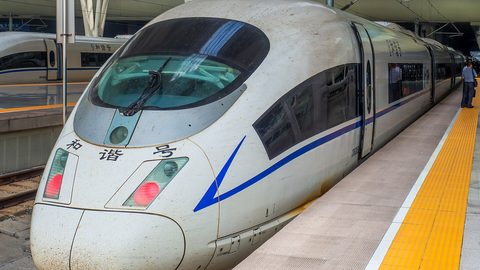
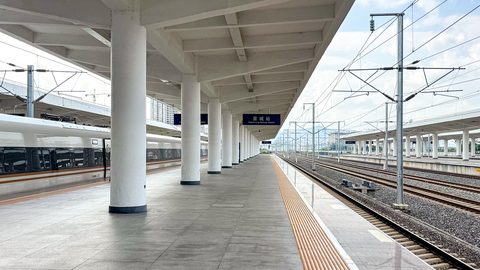
Both villages are accessible by high-speed rail. Huangshan North station is the principal gateway for the region; a tourist passenger transport centre adjacent to the station runs direct buses to Hongcun via Xidi. Yixian East station is closer, roughly 7 kilometres from Xidi, and local bus route 10 connects the station to both villages.
Ticket prices and opening hours for Xidi and Hongcun are set by the scenic area operators and change seasonally. The official Xidi operator publishes current pricing, and any visitor should check that source before travel rather than relying on a figure quoted elsewhere. Similarly, bus schedules and fares from both railway stations are subject to seasonal adjustment and operational revision. The Huangshan Scenic Area Management Committee issues timetable notices for the tourist transport centre, and China Railway publishes live train schedules on its official platform. Train frequencies and journey times change with each timetable revision.
Huizhou Ancient City in Shexian County, the historical seat of the prefecture, offers a different kind of visit. Its public streets are open all day without a blanket ticket, while the Huizhou Prefectural Government Office interior requires a separate timed ticket. This makes it a flexible option for travellers who want to experience the broader architectural context without committing to a full-day village itinerary.
For a first-time visitor aiming to understand Huizhou architecture in a single day, the strongest combination is one of the two UNESCO villages paired with an awareness of the craft and forms that appear in both. Xidi gives the denser architectural lesson; Hongcun adds the water system and a more expansive setting. Either choice, approached with attention to the three gems and the Three Carvings, provides a coherent introduction to a tradition that rewards looking slowly.
Sources and verification
- whc.unesco.org — Research source checked for this guide
- ahm.cn — Research source checked for this guide
- roamchinatravel.com — Research source checked for this guide
- gochinafreely.com — Research source checked for this guide
- chinahighlights.com — Research source checked for this guide
- gochinatravel.org — Research source checked for this guide
Read next
-
 Anhui Hotels from Huangshan Summit to Huizhou Courtyards
Huangshan summit hotels sell out weeks ahead and are the only legal way to sleep on the mountain; village guesthouses trade comfort for atmosphere.
-
 Where to Stay in Anhui for Huangshan and the Villages
Tunxi is the convenient transport hub, Tangkou suits hikers, summit hotels give sunrise access, and village courtyards offer atmosphere but less mobility.
-
 Flying to Anhui or Taking the Train From Shanghai Which Works Better
Flying into Tunxi puts you closest to the mountains, but the Shanghai to Huangshan North train often beats Hefei for total time.
-
 Things to Do in Anhui Beyond Huangshan and Hongcun
Beyond Huangshan, Anhui offers the Taoist Qiyun Shan, the Buddhist Jiuhua Shan, quiet villages like Chengkan, and Qimen black tea country.
-
 Best Time to Visit Anhui and Huangshan by Season
April–May and September–October offer the best Anhui weather, but avoid the first week of October and May for National Day and Labour Day crowds.
-
 Getting Around Anhui from Shanghai, Hangzhou and Nanjing
High-speed rail from Shanghai, Hangzhou or Nanjing to Huangshan North is the practical gateway, but villages and trailheads need buses or local cars.
-
 Huangshan (Yellow Mountain)
Huangshan's south gate, cable car choices and summit loop explained, so you can plan a realistic one- or two-day mountain route.
-
 Xuancheng
What Xuancheng prefecture offers travellers moving between Huangshan and the Yangtze, from paper-making towns to quiet bamboo valleys.
-
 Huangshan City
Tunxi is not Anhui's prettiest town, but its rail station, bus hub and Old Street make it the most useful base.