Huangshan in Fog or Rain What Is Still Worth Doing
A practical guide to Huangshan in Fog or Rain What Is Still Worth Doing.

Why Fog and Rain Are Features, Not Flaws
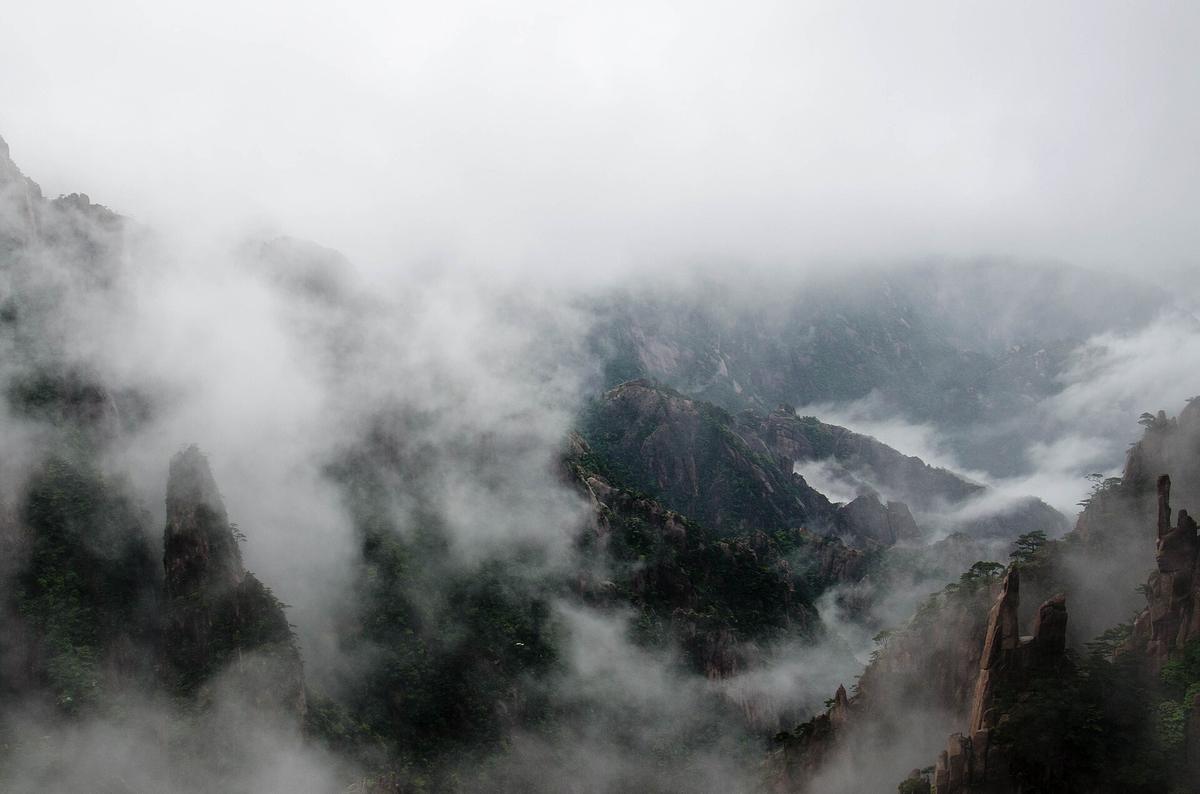
Huangshan's summit records roughly 260 foggy days and about 180 rainy days each year. Mist and precipitation are not aberrations that spoil a trip. They are the mountain's default condition and the very reason its landscape entered Chinese art and poetry. The granite peaks and ancient pines that define Huangshan do not vanish in low visibility. They shift into something closer to the ink-wash scrolls that made them famous, where form is suggested rather than shouted and every ridge recedes into a paler version of itself.
Accepting this changes what a visitor expects. A clear summit panorama is a bonus, not a baseline. The practical question is not whether fog or rain will appear, but what remains rewarding when they do. The answer, drawn from how the mountain's infrastructure, museums and nearby villages actually operate, is that a substantial trip survives poor visibility intact.
What the Mountain Itself Still Delivers
The Guest Welcoming Pine, a bristling horizontal limb supported by a stone prop, stands near the Yuping cable car station. At over a thousand years old and roughly ten metres tall, it is Huangshan's most recognisable living thing. Fog does not obscure it. The tree is close enough to the viewing platform that its bark texture and asymmetrical silhouette remain sharp even when the valley behind it disappears into white. The same holds for many of the summit's twisted pines. Their shapes read against mist as high-contrast outlines, the exact effect that classical painters sought with black ink on silk.
Granite faces behave similarly. Wet rock darkens, deepening the vertical lines and fissures that dry sunlight can flatten. Photographers working in fog often find that the absence of a distant horizon forces attention onto near-field detail: water beading on pine needles, the grain of a stone step, the way a railing disappears into vapour ten metres ahead. These are not consolation prizes. They are the mountain's core aesthetic in its most characteristic weather.

The Cloud Sea and When It Appears
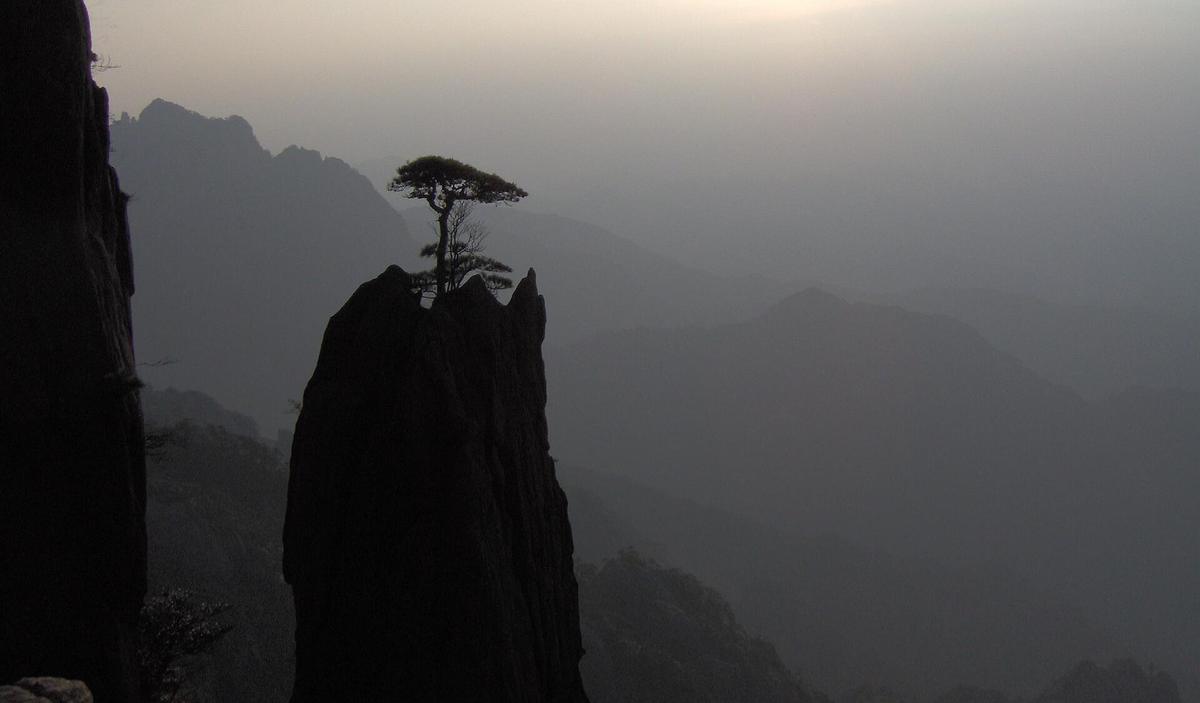
A specific phenomenon rewards those who stay patient through rain. The sea of clouds that fills valleys below the summits is most likely after precipitation clears, particularly from November through May. Cold air trapped beneath a warmer layer creates a dense, flat cloud deck, and Huangshan's peaks rise through it as dark islands. This is not a subtle effect. It is the mountain's single most celebrated visual event, and it depends entirely on the weather systems that produce rain or snow first.
The scenic area management committee publishes a daily mountain-specific forecast that includes cloud-sea probability and sunrise visibility. Checking this before ascending lets a visitor gauge whether conditions are building toward a clearing or settling into persistent grey. The forecast does not guarantee an outcome, but it provides the same data point that local guides use to decide whether to recommend an early start.
Indoor and Sheltered Options on the Mountain
The Huangshan Geopark Museum sits near the Yungu cable car station inside the scenic area boundary. Admission is included with the scenic area ticket. Its exhibits cover the geological processes that produced the mountain's granite spires, with interactive displays and a 4D cinema that do not depend on outdoor visibility. A large granite sculpture inside the museum gives a tactile sense of the rock texture that fog may hide outside.
During heavy rain, the scenic area management committee may close exposed sections such as Tiandu Peak and the West Sea Grand Canyon. When this happens, summit hotels open their lobbies and provide complimentary ginger tea to visitors who need shelter. This is an operational response, not a marketed amenity, but it means a rainy afternoon on the mountain does not leave a visitor without a warm place to sit. The three cable cars generally continue running in rain and fog, suspending only for thunderstorms or high winds. Their seasonal schedules are published, and their operating status on any given day should be confirmed through the management committee's notice platform before departure.
Down the Mountain in Hot Water
The Piaoxue Hot Spring sits at the foot of Huangshan in Tangkou Town, at an elevation of about 650 metres. Its water emerges year-round at roughly 42 degrees Celsius, feeding both indoor and outdoor pools. Rain does not close it. Soaking in an outdoor pool while cool mist drifts across the surrounding hills is a logical extension of a wet day on the summit rather than an escape from one. The spring operates as a separate ticketed facility from the scenic area. Admission prices and opening hours are not fixed across seasons, so confirming current details through the Huangshan Tourism Official Platform before visiting is prudent.
Tunxi Old Street and the Huizhou Culture Museum
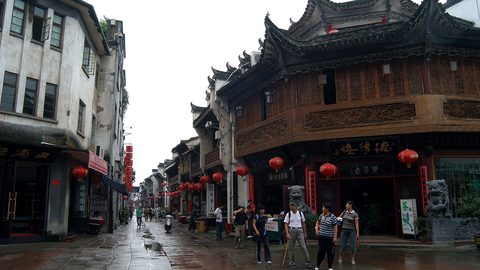
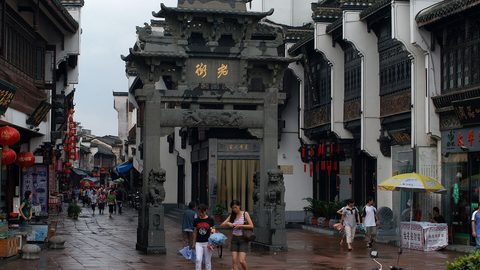
In downtown Huangshan City, Tunxi Old Street extends for 1,273 metres as a pedestrian commercial thoroughfare with continuous covered shopfronts. Rain does not interrupt it. The street has no gate, no admission fee and no closing time. Its teahouses, brush-and-ink shops and food stalls operate under deep eaves, and the flagstone paving grows slick and reflective in wet weather, which local photographers consider an improvement. A visitor can spend hours walking its length without needing an umbrella for more than the crossing of a side lane.
A short distance from the old street, the China Huizhou Culture Museum is free to enter with a passport. Its collection covers Huizhou architecture, merchant history, neo-Confucian philosophy and regional crafts. The museum opens from 9:00 to 11:30 and again from 13:30 to 17:00, closing on Mondays except during national holidays. For a traveller whose mountain day has been curtailed by weather, the museum provides the cultural context that explains why the villages and merchant houses of the region look the way they do. Seeing the architectural models and woodcarving examples indoors can reframe a subsequent visit to the actual villages, especially if that visit happens in rain.
Hongcun and Xidi in the Wet
Hongcun and Xidi, both UNESCO World Heritage villages roughly 50 kilometres from the Huangshan mountain base, are widely described as more atmospheric in light rain or mist than in full sun. The whitewashed walls and black tiles of Huizhou architecture were designed in a wet climate, and their appearance in mist is not a degraded version of the clear-day view. It is the view that the builders anticipated. Moon Pond in Hongcun and South Lake in Xidi hold reflections that soften and blend when raindrops disturb the surface, producing the exact ink-painting aesthetic that draws painters and photographers to the region.
These villages are not on the mountain. They require separate transport and a separate ticket. But a rainy summit morning followed by a misty village afternoon is a coherent itinerary, not a compromise. The two experiences reinforce each other. The mountain shows the geology and the pines. The villages show what Huizhou craftsmen built with the wealth that the landscape's isolation helped preserve.
Planning Around Uncertain Conditions
A workable wet-weather strategy for Huangshan rests on a few verifiable operational facts. The mountain's three cable cars run on published seasonal schedules and typically continue through rain and fog, suspending only for thunderstorms or high winds. The scenic area management committee issues daily weather forecasts that include cloud-sea probability. Summit hotels provide shelter and hot drinks when trails close. The hot spring at the mountain base operates in rain. Tunxi Old Street is covered and always open. The Huizhou Culture Museum is free and indoors. Hongcun and Xidi reward mist.
Several details require same-day confirmation. Cable car operating status during adverse weather should be checked through the management committee's notice platform. The opening or closure status of Tiandu Peak and the West Sea Grand Canyon must be verified before departure via the official tourism platform. Summit hotel availability is tight in peak periods and demands advance reservation through the same platform. None of these checks are burdensome. They are the difference between hoping the weather cooperates and knowing what remains available when it does not.
Sources and verification
- hstd.com — Research source checked for this guide
- huangshantourguide.com — Research source checked for this guide
- chinadaily.com.cn — Research source checked for this guide
- chinavigators.com — Research source checked for this guide
- chinatravel.com — Research source checked for this guide
- huangshan.gov.cn — Research source checked for this guide
Read next
-
 Tunxi Old Street
 fills the evening before a Huangshan climb with Huizhou snacks, tea shops and a restored Ming-Qing streetscape.
-
 Anhui Hotels from Huangshan Summit to Huizhou Courtyards
Huangshan summit hotels sell out weeks ahead and are the only legal way to sleep on the mountain; village guesthouses trade comfort for atmosphere.
-
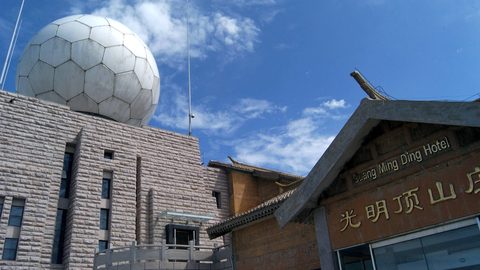 Where to Stay in Anhui for Huangshan and the Villages
Tunxi is the convenient transport hub, Tangkou suits hikers, summit hotels give sunrise access, and village courtyards offer atmosphere but less mobility.
-
 Flying to Anhui or Taking the Train From Shanghai Which Works Better
Flying into Tunxi puts you closest to the mountains, but the Shanghai to Huangshan North train often beats Hefei for total time.
-
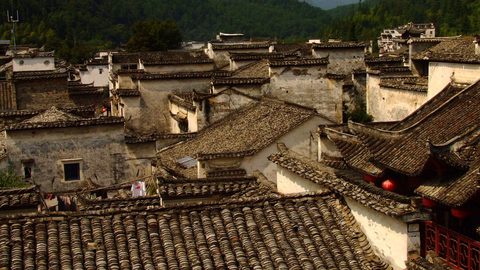 Things to Do in Anhui Beyond Huangshan and Hongcun
Beyond Huangshan, Anhui offers the Taoist Qiyun Shan, the Buddhist Jiuhua Shan, quiet villages like Chengkan, and Qimen black tea country.
-
 Best Time to Visit Anhui and Huangshan by Season
April–May and September–October offer the best Anhui weather, but avoid the first week of October and May for National Day and Labour Day crowds.
-
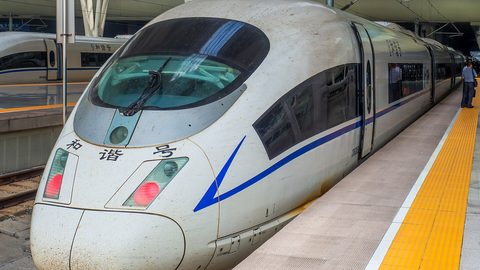 Getting Around Anhui from Shanghai, Hangzhou and Nanjing
High-speed rail from Shanghai, Hangzhou or Nanjing to Huangshan North is the practical gateway, but villages and trailheads need buses or local cars.
-
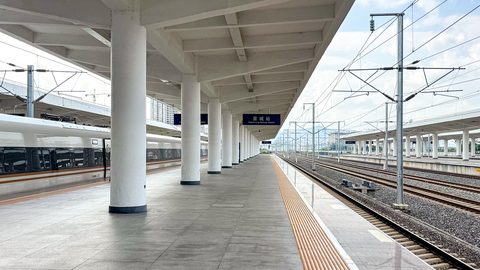 Xuancheng
What Xuancheng prefecture offers travellers moving between Huangshan and the Yangtze, from paper-making towns to quiet bamboo valleys.
-
 Huangshan City
Tunxi is not Anhui's prettiest town, but its rail station, bus hub and Old Street make it the most useful base.