A Field Guide to Huizhou Architecture in Anhui
Horse-head gables, whitewashed walls and narrow stone lanes: how to read the architecture of Anhui's Huizhou villages.

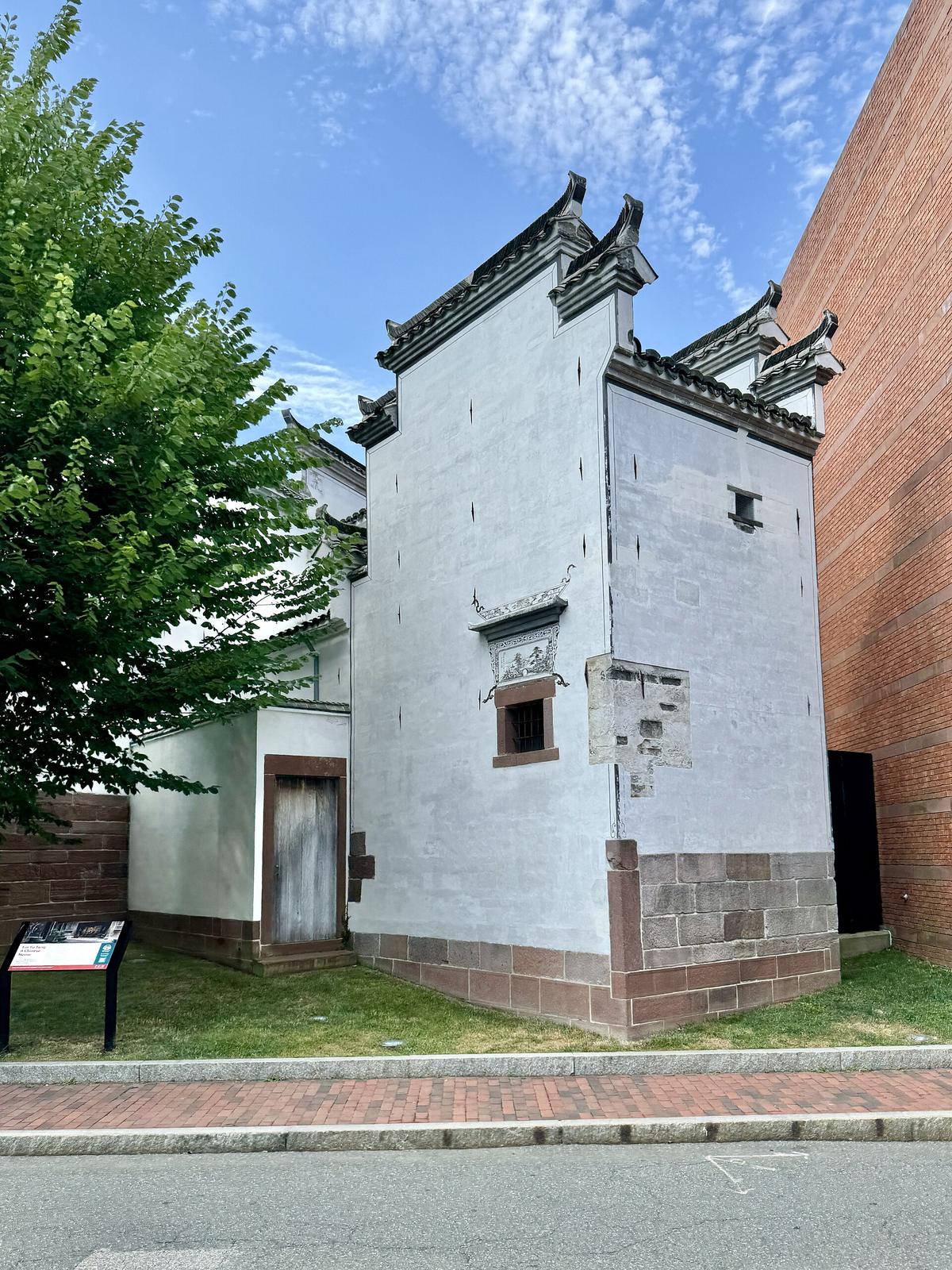
Horse-Head Gables and Fire Walls
You walk into Hongcun and see white walls, dark roofs and horns on every building. Those horns have a name and a job. The name is horse-head gable. The job is fire prevention. Builders in historical Huizhou Prefecture, covering the six counties of Shexian, Xiuning, Yixian, Qimen, Wuyuan and Jixi, faced a problem: timber houses packed into tight lanes. A fire in one house could take the whole settlement. Their solution was the Ma Tau Qiang, a masonry step-up rising 0.5 to 1.2 metres above the roof plane. The wall blocked flame spread across adjacent structures. The tier count, from one to five, told you the owner's status and wealth. More tiers meant more money. Read a settlement the same way you read a person. Hongcun, Xidi, Chengkan and Guanlu are your living textbooks for this visual language.
The White Walls and Dark Roofs: What They Are Made of and Why
The walls are not white paint. The builder took hollow cavity brick, laid it with lime-and-clay mortar, then plastered the surface with lime putty mixed with rice paste and tung oil. That finish aged into the soft white you see today. The roof tiles are local grey clay, reduction-fired into dark grey or black. Small-format pan-and-roll tiles cover every roof in overlapping rows. You will never see a bright red tile in a Huizhou settlement. That is a modern mistake from a renovation budget with no eye for history.
Horse-Head Gables: Not Decoration, Defence
The stepping profile has a name you already know: horse-head gable. Forget horses. The shape emerged from practical fire-break engineering. The vertical step-up rose above the roof plane and forced a break in the combustible timber line. In Xidi, look at how the gables march along a lane. They create a rhythm that modern architects would call handsome. The original intent was survival. The aesthetic came free.
House orientation follows fengshui and micro-topography, with south-facing as the default. But the main gate never points directly down the lane axis. It gets offset or screened by a spirit wall. You enter a courtyard, not a street. That is deliberate. The spirit wall blocks bad energy and stops strangers from seeing into the house. Privacy and protection, not just superstition.
Sky-Wells: the Courtyard That Collects Rain, Light and Luck
The central courtyard is not a hole in the roof. It is called tian jing, which means sky-well. Dimensions run 1.5 to 3.0 metres wide and 2.0 to 5.0 metres long, varying with the house bay width. The floor is stone-flagged with a central drainage sump connected to underground channels that feed the settlement water system. All four roof slopes pitch inward. Rainwater drains to the stone cistern or pond below. That is the principle of si shui gui tang, four waters returning to the hall, a symbol of wealth retention. A merchant who built a house with inward-pitching roofs was saying, literally, that money stays inside.
The sky-well also brings daylight into the interior hall. At midday, illuminance at ground level ranges from 200 to 800 lux depending on season and latitude. That is enough to read by. It also creates ventilation. Warm air rises and exits through the open top, pulling cooler air via ground-floor openings. The house breathes without a mechanical system.
Narrow Lanes and Windowless Walls
Walk Guanlu and you feel the walls crowd in. That is the point. Lanes are narrow to maximise shade and keep the settlement cool. Exterior windows are minimal: high, small openings on the upper floor only. The ground floor is a solid white wall to the street. Security and privacy drove this. Merchants stored goods on the ground floor. They did not want anyone seeing in. The upper floor held storage and unmarried women. Slit windows gave light and air without giving sightlines to the street.
House layout follows a central axis: entrance hall, then sky-well, then main hall, then rear sky-well if the house had one, then upper hall. Flanking wings held side rooms. The timber frame is post-and-beam, either chuandou style or tailiang style. The walls are non-load-bearing. They hold nothing up. That is why you can cut a new window into a Huizhou wall without structural collapse. Do not, because you would break the street elevation.
The Carvings That Tell You Who Lived There
Wood carving peaked between 1550 and 1800, from late Ming to mid-Qing. Look at the beams, bracket sets, spandrels, partition panels, window lattices and second-floor gallery railings. The best surviving wood carving sits in Chengkan. That settlement draws fewer crowds than Hongcun, which means you can examine the detail without a tour group blocking your view.
Brick carving appears on gatehouse facades and above-door lintels. The best example is the Qingyi Hall gatehouse in Xidi. Stand across the lane and study the layered depth. The carver cut through multiple planes of brick to create a scene that catches shadow and sunlight differently across the day.
Stone carving goes on column bases, door thresholds, sky-well perimeter edging and memorial archways. The best site for stone carving archways is the Tangyue Memorial Archway complex in Shexian county. Seven arches span the Ming to Qing dynasties in a single line. Each arch marks a virtue: filial piety, chaste widowhood, government service. Read them like a timeline of what the culture valued enough to carve in stone.
Water Systems: The Infrastructure That Made Settlement Life Possible
Hongcun's water system dates to the early 15th century, commissioned in 1403 by He Keda. Artificial canals channel stream water across the settlement. Every house had access to running water for washing, cooking and firefighting. The system ends at the crescent pond, which doubles as a social and visual focal point. Xidi uses a similar network. Look for the stone channels running along the lane edges. They are not decorative gutters. They are the circulatory system. Without them, density would have been impossible.
Guanlu uses a different arrangement. Its fortified layout includes a defensive wall system, unique among Huizhou settlements. The water system there feeds a central pond designed for defence and daily use. You can spot the difference in the settlement's grain: tighter, more closed, built by a clan that faced more external threats than the merchants of Hongcun.
The Merchants Who Paid for it All
Every white wall, every carved beam and every stone archway was funded by Huizhou merchants, the Huishang. Their trade goods were salt, tea, timber, ink-stones and rice paper. The salt monopoly under the Ming dynasty, continuing through the Qing, made the Lianghuai salt merchants staggeringly wealthy. The peak period for merchant wealth ran from the 16th century through the early 19th century, roughly the Jiajing through Jiaqing reigns. Those merchants returned to their home settlements and built the houses, halls and archways you see today.
They did not build to show off to strangers. They built to show off to their own clan. The ancestral hall stands as the most prominent building in every settlement, at the centre or the highest point. That hall validated the family's status. The carvings inside it encoded the family's values: scholarly success, official rank, filial piety. Decode a clan's priorities by walking from the entrance to the ancestral hall. The route passes through increasingly elaborate gatehouses and increasingly refined carvings. By the time you reach the hall, you understand exactly who ruled this place and what they wanted you to value.
Three events broke the system. The Daoguang-era salt monopoly reforms of the 1830s ended hereditary salt certificates and destroyed the merchant class's financial base. The Taiping Rebellion from 1850 to 1864 ravaged Huizhou and the Yangtze trade routes. The rise of Shanghai as a treaty-port commercial centre shifted trade away from inland Huizhou networks. After those blows, the money stopped flowing and the building stopped. What remains is a frozen moment from the 16th to 19th centuries, preserved by subsequent poverty and neglect rather than by any preservation plan.
How to Look at Any Huizhou Settlement Right Now
Arrive by 08:30, before the tour buses from Tunxi arrive. Walk to the water source first. In Hongcun that means the crescent pond. In Xidi it means the canal network near the entrance. Trace the path of the water along the lanes. It tells you the growth pattern. The oldest houses sit closest to the water source.
Count the tiers on the horse-head gables. One or two tiers means a modest family. Three or four means a merchant with serious wealth. Five means the building is an ancestral hall or a government structure. Look at the gable on the Qingyi Hall gatehouse in Xidi for the maximum tier count.
Examine the door threshold. A high stone threshold means the owner held official rank, not just money. A carved threshold means the family had scholarly achievement. An unadorned threshold means the building was purely residential with no official status.
Check the exposed timber inside the main hall. Late Ming carvings are more deeply cut and less crowded than Qing carvings. The Qing carvers added more detail but lost the boldness. Date a house to within fifty years by studying the carving density on a single main beam.
Skip the mid-afternoon visit to Hongcun. The sunlight in the sky-wells is harsh and the crowds are thick. Go to Chengkan or Guanlu instead. Chengkan has the best surviving wood carving in the region. Guanlu has a fortified layout you will not see anywhere else. Both are quieter than the UNESCO settlements, which means you can stop and read the architecture without being jostled.

| Settlement | Best For | Crowd Level | Time Needed | Key Feature |
|---|---|---|---|---|
| Hongcun | First-timers, photography, water system | Very crowded by 10am | 2-3 hours | Crescent pond and canal network |
| Xidi | Ancestral halls, gatehouse carving | Moderate | 2-3 hours | Qingyi Hall gatehouse brick carving |
| Chengkan | Wood carving, quiet exploration | Low to moderate | 2-4 hours | Best surviving wood carvings in the region |
| Guanlu | Fortified layout, defence architecture | Very low | 1.5-2 hours | Unique defensive wall and compact lane system |
The One Thing to Do Before You Go
Book your Huangshan summit accommodation before you book the settlements. The summit hotels sell out weeks ahead during April, May, September and October. Without a summit room you cannot see sunrise from the peak, and the last cable car down leaves by 17:00. Lock in the mountain first, then add a settlement day on either side. From Tangkou, the town at the south entrance of Huangshan, you can reach Hongcun or Xidi in about an hour by car. That makes a two night, one settlement itinerary the most practical route: sleep in Tangkou, ascend the mountain, descend, then move to a settlement for a full day of walking its lanes before you leave. That sequence saves you the 3 to 4 hour transfer times that trip up travellers who try to base everything in Tunxi and commute to the mountain and the settlements from there.
Common Questions
Why are the walls white instead of bare brick?
The lime wash is a functional coating, not an aesthetic choice. Lime putty mixed with rice paste and tung oil sealed the brick against moisture and insects. The white surface also reflected sunlight and reduced heat gain in summer. The brick beneath is a hollow cavity type, which provided insulation on its own.
Why do the roofs pitch inward instead of outward?
The inward pitch directs rainwater into the central sky-well, where it drains through a stone sump into the settlement's underground water channels. This is the principle of "four waters returning to the hall," symbolising that wealth stays within the family. Outward pitch would have sent water into the lane and signalled that money was leaving the household.
Is the architecture the same in every Huizhou settlement?
The core elements are consistent: white walls, dark tiles, horse-head gables, sky-wells and timber frames. But each settlement has a distinct layout. Hongcun is organised around water channels. Xidi is more compact with grander ancestral halls. Chengkan follows a Bagua cosmological plan. Guanlu is fortified with defensive walls. You can see all four distinct solutions in a single day trip from Tunxi, taking about 40 to 60 minutes by car to each.
Why are the windows so small and high up?
Ground-floor windows on the street side were kept small or omitted entirely for security and privacy. Merchants stored valuable trade goods on the ground floor. The high, small windows on the upper floor provided light and ventilation while preventing anyone from seeing inside. Women lived and worked on the upper floor, and these windows maintained their privacy while allowing air circulation.
How do I tell a merchant's house from a scholar's house?
Look at the carvings. Merchant houses emphasise wealth symbols: peonies, bats for luck, linked coins for prosperity. Scholar houses show books, brush holders, plum blossoms and pine trees. The door threshold also differs. A high stone threshold indicates the owner held government rank, which required passing the imperial examinations. A low threshold with elaborate carving suggests the owner bought status rather than earned it through exams.
Read next
-
 Getting to Anhui from the Rest of China and How Long You Really Need
High-speed rail routes to Anhui explained: which stations to use from Shanghai, Hangzhou, or Beijing, and how many days Huangshan really needs.
Getting to Anhui from the Rest of China and How Long You Really Need
High-speed rail routes to Anhui explained: which stations to use from Shanghai, Hangzhou, or Beijing, and how many days Huangshan really needs.
-
 Reaching Anhui Visa-Free Through China's Transit Rules for a Huangshan Side Trip
How China's 240-hour visa-free transit rules let you reach Huangshan and the Huizhou villages without a full visa.
Reaching Anhui Visa-Free Through China's Transit Rules for a Huangshan Side Trip
How China's 240-hour visa-free transit rules let you reach Huangshan and the Huizhou villages without a full visa.
-
 Golden Week in Anhui, the Weeks to Avoid and What to Do If You Cannot
What Golden Week does to Huangshan, Hongcun and Anhui transport, and the few ways to reduce the damage if you must travel then.
Golden Week in Anhui, the Weeks to Avoid and What to Do If You Cannot
What Golden Week does to Huangshan, Hongcun and Anhui transport, and the few ways to reduce the damage if you must travel then.
-
 Huangshan or Zhangjiajie, Which China Peak Landscape Fits Your Trip
Huangshan's granite peaks and Huizhou villages or Zhangjiajie's sandstone pillars: which mountain landscape suits your China trip.
Huangshan or Zhangjiajie, Which China Peak Landscape Fits Your Trip
Huangshan's granite peaks and Huizhou villages or Zhangjiajie's sandstone pillars: which mountain landscape suits your China trip.